Tomorrow.io’s July 2026 release — the Weather Resilience Platform.
This release meets your operation where it already works — in your industry’s language, your team’s structure, and your own software.
Every weather decision runs the same course. A force develops in the sky. It reaches a workflow you already run. Someone has to make a call. That call carries a consequence — a cost avoided, a delay absorbed, a crew kept safe. And at the end of it is a person accountable for how it turns out.
Tomorrow.io has never asked you to meet it on its terms — its map, its thresholds, one more screen to watch. Across the experiences you build on, the alerts you receive, the systems you connect, and the data underneath, the platform keeps taking the shape of the operation you already run. This release is the latest proof.
Shaped like your industry — Labs keeps getting more personalized
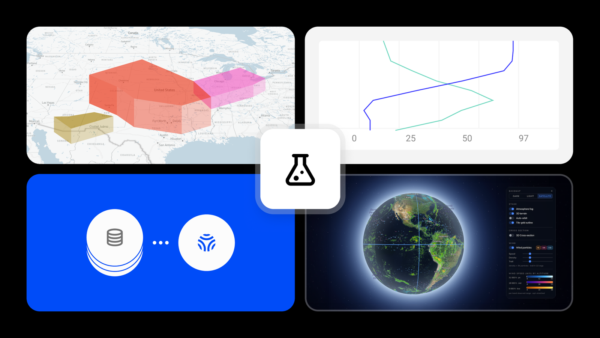
An airline doesn’t think in “weather layers.” It thinks in banks, holdover windows, and re-banking a schedule that just came apart. A live-event team thinks in holds and resumptions. Labs is continuing to become an exceptional place where Tomorrow.io meets that personalization — capabilities organized around your industry and your use case, not a flat catalog you have to translate yourself.
This release pushes that further into your AI roadmap. Every block in Labs now carries a visible maturity — from early concept through beta to generally available — so you know exactly what you’re adopting. And the library of deployable experiences keeps growing: the Lightning & Thunderstorm block takes the hardest question an outdoor operation faces — not “is there lightning?” but “when is it safe to resume?” — and turns it into a countdown you can read across every site at once.
Read the deep dive: how Labs keeps getting more personalized →
Shaped like your team — grouped alerts
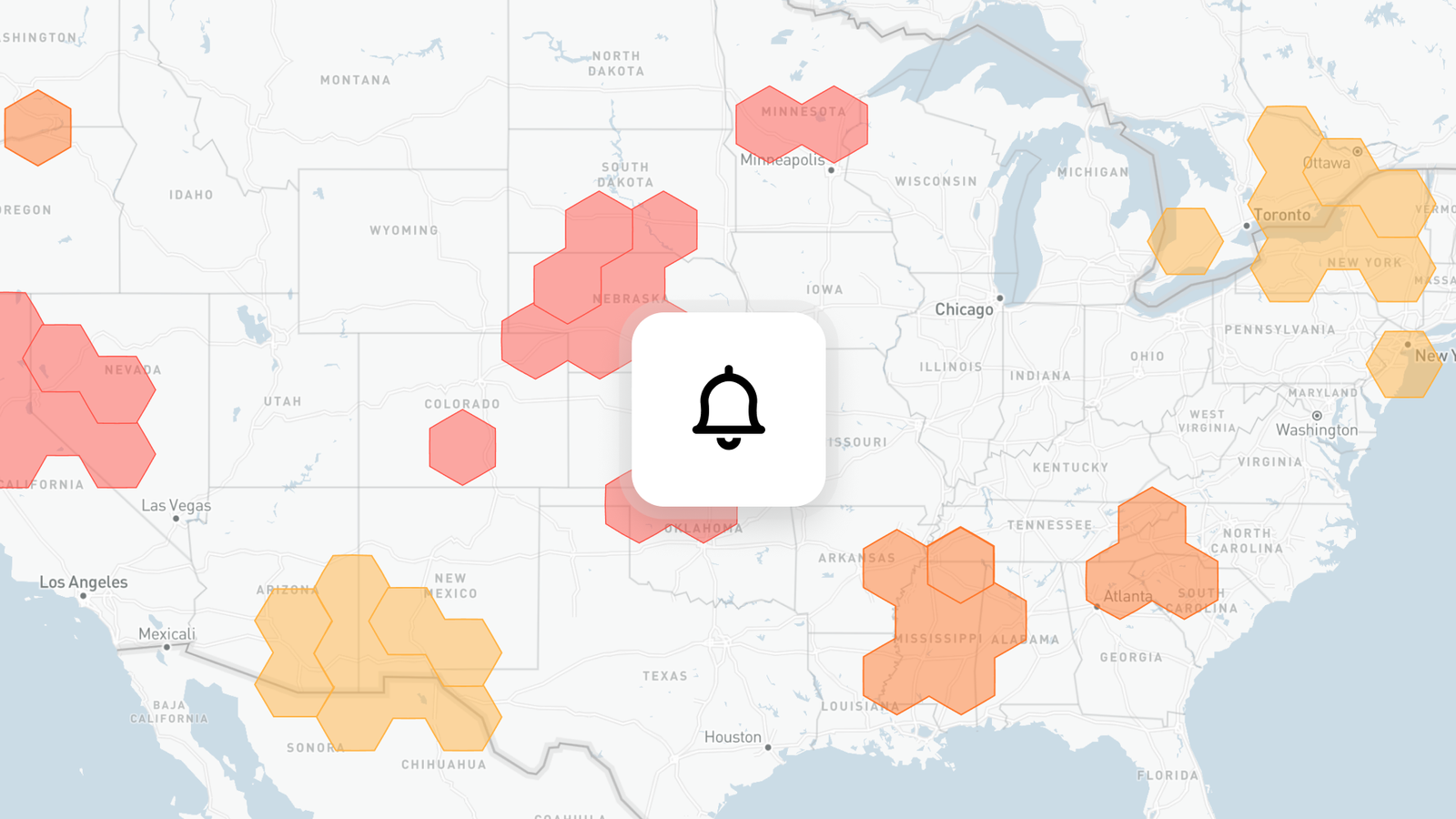
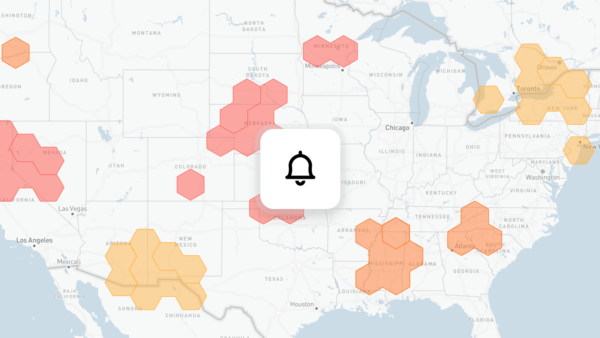
One storm crossing five hundred monitored sites used to mean up to three notifications per location — enough volume to bury the one message that mattered. Grouped alerts changed the unit of notification from the location to the group, and this release makes each message carry more: one notification now lists every impacted location with its timing, attaches the full list as a CSV, and links to a map already filtered to exactly that group. It also reports when the story changes in either direction — not only a cancellation or an earlier start, but a delayed start and a change in duration.
Fewer messages, each carrying more.
Read the deep dive: why more alerts don’t make an operation safer →
Shaped like your systems — Gale API, MCP, and CVE
Often the decision doesn’t happen on our screen at all. It happens inside your dispatch software, your claims system, or an AI agent your team is building right now. This release meets it there, three ways.
The Gale API makes conversation something your applications can hold directly: plain-language weather questions and forecast summaries as endpoints, aware of your account context, able to continue across a session, returned in your language, units, and timezone. The MCP server adds three tools — AI chat, AI summaries, and data feeds — bringing the set to ten that any compatible agent can call natively: public URL, an API key, live. And Custom Vector Events now carry what downstream systems need to treat a weather event as a thing they track: a persistent identity, a lifecycle from new to updated to cancelled, the values behind the trigger, and a resolution you choose to match your operational tempo. Rail, insurance, and logistics teams already consume weather this way — not as a lookup, but as an object they hold.
Read the deep dive: ask, call, hold →
The rest of the release
- Forecasts as ranges, not single numbers. Accumulation Probability shows the likely range for rain, snow, and other accumulation — on the timeline, in trends, on dashboards, and in reports — so a response can be sized to the actual risk. Built with a national emergency-management agency’s flood response in mind.Read the deep dive: what a 20% chance is worth →
- Every flight the weather touches. Impacted flights now surface in the Insights Timeline, and the timeline exports as a document you can share — closing the gap between seeing the risk and sending the report.Read the deep dive: every flight the weather touches →
- Your operational views, on mobile. Open any of the views you already use inside the mobile app — the same locations and context, for the people making calls away from a desk.
- Every active storm, one place. A new Active Storms view lists tropical systems worldwide and jumps to any of them on the map.
- Two data sources added. Global snow-water-equivalent coverage, and NOAA’s peak storm-surge flooding map — available to all platform accounts.
And a look at where the experience is headed
Alongside what shipped, we’ve begun rebuilding the map experience from the ground up — starting with a fast, clean front door we’re calling the Lite Map. It’s an early look, in the hands of a few design partners, and it’s the first floor of a longer climb toward the operational context and proprietary data underneath. Not a switch to flip today — a direction worth seeing.
Where we’re headed: the fast way in →
One release, one idea
None of these stands alone. Together they are a single motion the platform has been making for a long time: weather intelligence that arrives in the shape of the work you already do — your industry’s language, your team’s structure, your own systems.
Explore the release in the platform, and follow the deep dives — on your industry, your team, your systems, the data underneath, and where the experience is headed — over the coming days.
▽