
The Genesis Mission’s first 278 projects were announced on July 22, 2026. This piece is about one of them — and about the reason its central question is harder than it sounds.
A plant operator deciding whether to bank on cooling water next month is not really asking how much water there will be. They are asking whether they will cross a line, and how likely that is. Those are different questions. Most forecasts answer the first one.
Every water decision is a threshold decision
Is there enough flow to run the turbine. Is the intake temperature low enough to keep the plant at full output. Does the reservoir clear the level where releases get restricted. None of those is a question about a quantity. Each is a question about a line — and the useful answer is never a single number, because a single number carries no information about how close the call was, or how often the other outcome shows up.
An operator handed 259 billion kilowatthours learns nothing about the risk they are carrying. An operator handed a range with odds attached can act on it: hedge, pre-position, buy the cover, or leave it alone. The first is a fact. The second is a decision.
Energy runs on water, and the ceiling moves
It is easy to think of water as an environmental constraint on the power system. It is more accurate to call it an input. Thermoelectric plants — coal, gas, nuclear — need water to carry away heat; in the United States, thermoelectric generation accounted for 41 percent of all water withdrawals in 2015, the largest single category of use in the country.1 Hydropower is a smaller share of generation but a sharper instrument: 5.6 percent of U.S. utility-scale electricity in 2025, and one of the few sources that can be moved up or down on demand.2
Neither constraint sits still. EIA expects U.S. hydropower generation of 259 billion kilowatthours in 2026 — a recovery from the 245 billion of 2025, itself only about 4 above the record low set in 2024 — and still 1.8 percent below the ten-year average, following snow drought in several states.2 Record-warm winter temperatures and a March heat wave across much of the West drove early snowmelt through California, the Southwest and parts of the Northwest.
Snowpack is where this becomes concrete. As of April 1, 2026, the Northern Sierra Nevada sat at 7 percent of normal, the Central Sierra at 25 percent, the Southern Sierra at 39 percent.2 Those are not three shades of the same answer. They are the difference between a normal operating year and a scramble.
A watershed inherits the uncertainty of the sky above it
This is the part that makes the problem structural rather than merely difficult. Hydrologic models are driven by atmospheric forcing — precipitation, temperature, humidity, wind. Give one of those models a single precipitation number and it returns a single answer, stated with a confidence it has not earned. Give it a range and it returns a range.

Which means uncertainty discarded at the top of the model cannot be recovered further down. If the purpose of the system is to return odds, the atmospheric input has to arrive as odds. Getting the forcing right is not a data-delivery problem sitting upstream of the science. It is part of the scientific question.
What the Department of Energy selected
The Genesis Mission was created by executive order on November 24, 2025, with a plainly stated goal: double the productivity and impact of American research and innovation within a decade.3 The mechanism is to put supercomputing, AI models and federal scientific datasets on a single foundation and run it through the national laboratories.
The first call drew what Darío Gil, the Department of Energy’s (DOE) Under Secretary for Science and Innovation, called “the largest response rate in the history of the department for any specific program” — more than 5,000 proposals.4 On July 22, 2026, the Department announced the first 278 selections, spanning 342 institutions across all 50 states, including 142 universities, 157 companies and 16 national laboratories, selected onto the same projects rather than into separate lanes.5
2025
2026
2026
The full announcement, including the institutional breakdown and the composition of the first cohort.
One of them is led by a team at Pacific Northwest National Laboratory (PNNL), with Xingyuan Chen as principal investigator: an AI-guided model–experiment framework for predicting water availability in energy systems, using multi-fidelity watershed modeling. Two study watersheds anchor it — South Branch Kishwaukee in Illinois and Oak Creek in Washington — deliberately different hydrologies.6,7
Multi-fidelity is the operative word. Detailed physical models of a watershed are expensive to run, which makes it impractical to run the many simulations an honest uncertainty estimate requires. Cheaper approximations can be run many times but drift from the physics. Coupling them under AI guidance is an attempt to get the coverage without surrendering the rigor — and to let the model say where the next experiment or measurement would actually reduce the uncertainty, rather than simply adding data.
Where the atmosphere comes in
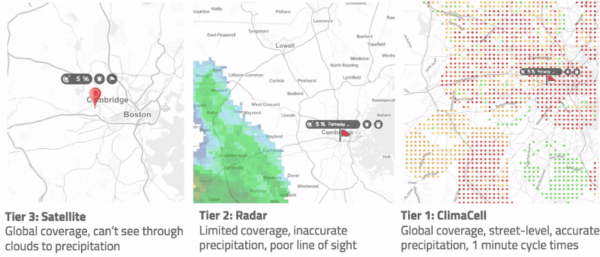
This is the part we work on. PNNL leads the science. Tomorrow.io is a named collaborator contributing precipitation and surface meteorology — the atmospheric forcing the watershed models use — and Forest Cannon is a co-investigator on the team, alongside Sarah Allec and Paul Rigor at PNNL and Alex Tartakovsky at the University of Illinois Urbana-Champaign.
Phase I is a foundation, not a finish line.
The test at the end of it is not technical, and it is not whether the models run. It is whether the simulations can inform an operator to answer the question they actually had — how likely am I to cross the line. If what comes back is still a single number, nothing has changed.
Sources
- U.S. Geological Survey. Thermoelectric power water use — thermoelectric generation accounted for 41 percent of total U.S. water withdrawals, 34 percent of freshwater withdrawals and 48 percent of fresh surface-water withdrawals (2015 reference year).
- U.S. Energy Information Administration (2026).Hydropower generation expected to recover despite snow drought in the West — 2025 generation of 245 BkWh against the 2024 record low; 2026 forecast of 259 BkWh, 1.8% below the ten-year average; April 1, 2026 snowpack at 7% (Northern Sierra), 25% (Central Sierra), 39% (Southern Sierra); hydropower at 5.6% of 2025 U.S. utility-scale generation.
- Executive Order (November 24, 2025). Establishes the Genesis Mission and its objective of doubling the productivity and impact of American research and innovation within a decade.
- Darío Gil, DOE Under Secretary for Science and Innovation, to Nextgov/FCW, July 22, 2026: “We received over 5,000 proposals, the largest response rate in the history of the department for any specific program.” The proposal count is not published on a DOE page; this on-record statement is its source.
- U.S. Department of Energy (July 22, 2026). Announcement of the first Genesis Mission selections — 278 projects, 342 institutions, all 50 states; 142 universities, 157 companies, 16 DOE and NNSA national laboratories, 13 non-profits and 14 other institutions; 87 lab-led, 168 university-led, 19 company-led, 4 non-profit-led.
- U.S. Department of Energy (July 22, 2026). Genesis Mission awards list, announcement DE-FOA-0003612 — project title, principal investigator and lead institution for all 278 selections. The two study watersheds are not on it, or on PNNL’s awards summary; both were confirmed by PNNL directly.
- Pacific Northwest National Laboratory (July 2026). Genesis Mission awards listing — AI-Guided Model-Experiment Framework for Predicting Water Availability in Energy Systems Using Multi-Fidelity Watershed Modeling, Xingyuan Chen.