
On October 1, two more Tomorrow.io microwave sounders, Tomorrow-S12 and S13, launched aboard SpaceX’s Transporter-18 from Vandenberg Space Force Base. They joined the fleet that reached a 60-minute global revisit in January and today runs well below it. This is how we got here, why that hour matters, and what comes next.
Nine rides to orbit
Every satellite we have flown went up as a rideshare on a SpaceX Falcon 9, sharing the ride with other spacecraft. The first two, in 2023, were pathfinders that operated precipitation radar from a small satellite. Since August 2024, every launch has carried microwave sounders: instruments that read the temperature and moisture of the atmosphere through cloud.
Why revisit is the number we chase
A satellite in low Earth orbit passes over any one place only a few times a day. The atmosphere doesn’t wait that long: a storm can form, deepen and reach land between two passes. Revisit is the time a place waits between looks, and it sets how fresh a forecast’s starting picture can be.
Each satellite we added shortened that wait. In January, our 10th and 11th sounders brought the constellation to a 60-minute global revisit, the cadence Sky 1 runs on to rebuild the global atmospheric picture every hour. Today, our global revisit runs well below 60 minutes.
Keeping Gen-1 fresh
Before this launch, eleven Gen-1 microwave sounders were active in low Earth orbit. Tomorrow-S12 and S13 are Gen-1 sounders too. With them, the work turned from building the constellation to keeping it fresh: adding satellites so the hourly picture keeps its hour as the fleet ages.
What comes next: DeepSky
DeepSky is our next generation, now being built. Each DeepSky spacecraft will carry five instruments: Gen-2 hyperspectral microwave sounders, GNSS radio occultation, GNSS reflectometry, infrared and visible imaging, and precipitation radar. All five fly on the same spacecraft at the same time, so they read the same column of atmosphere together.
It is aimed at the places where warning arrives late. Roughly 71 percent of Earth is ocean with virtually no ground-based weather radar, and more than five billion people live outside radar coverage entirely.
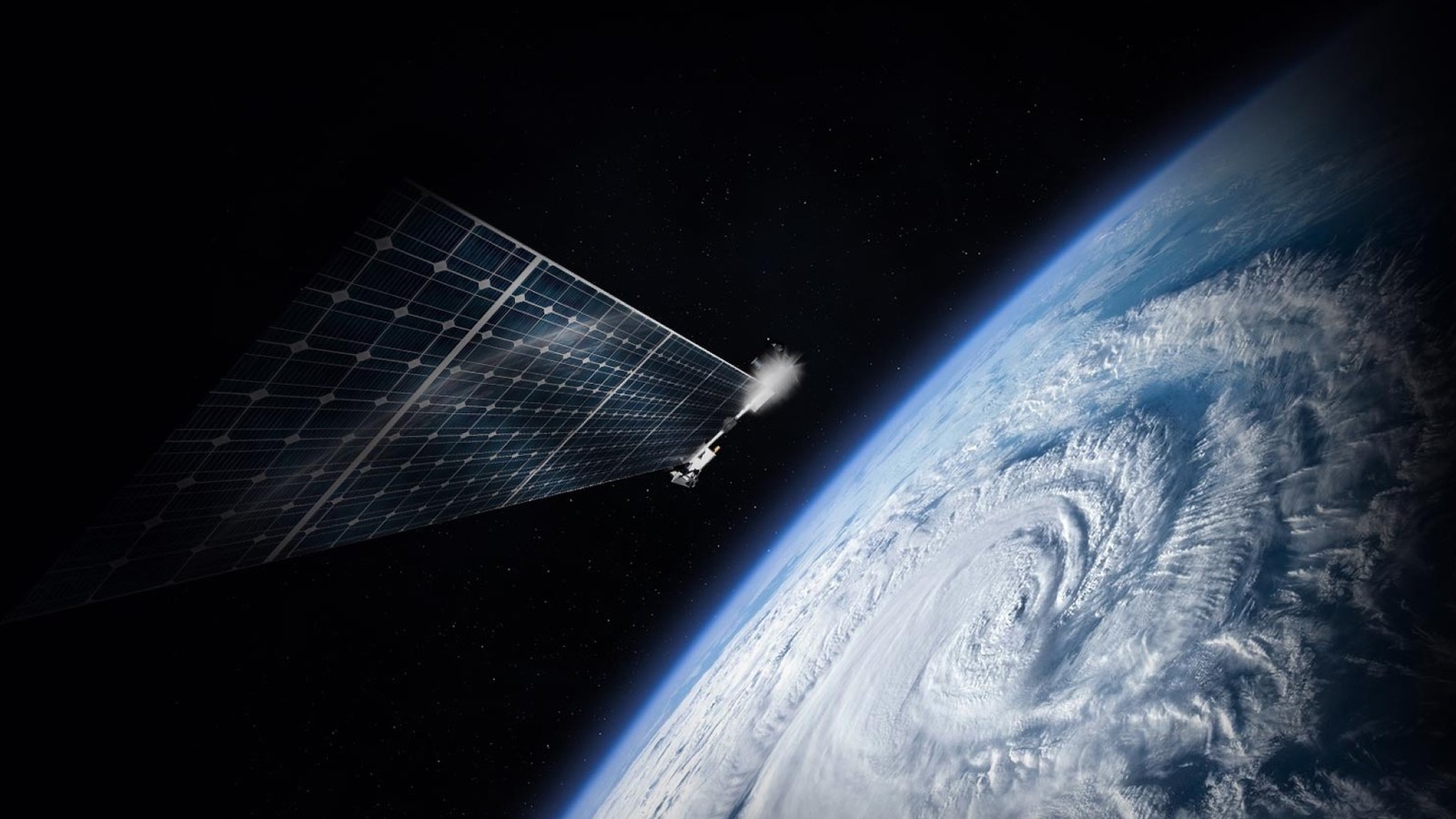

What each of the five instruments reads, and why all five have to fly on the same spacecraft.
From the instrument to the decision
We design and build the instruments, test them end to end before they fly, operate them in orbit, validate what they measure, model the data, and deliver it into the operations of the people who depend on it.
We made contact with it only an hour later and were able to start getting data down. That is very much a culmination of all your effort, wrapped up into one moment. — Jack Dalimore, Technical Program Manager, Tomorrow.io, 2025
Governments build on it too. In June, NOAA’s National Environmental Satellite, Data, and Information Service awarded us a contract to provide microwave sounder observations under its Microwave Sounder Data Buy. In September, NASA’s Commercial Satellite Data Acquisition program began a formal evaluation of our sounder data.
And the forecasts reach the field. In Kenya, a two-year pilot with TomorrowNow.org and One Acre Fund sent our forecasts by SMS to nearly 10,000 smallholder farmers, and their yields rose 12% relative to a control group. With TomorrowNow, our forecasts now reach millions of farmers in East Africa.
The team behind it
Behind every launch in the timeline above are years of work that come down to a single launch window. Engineers designed and built instruments small enough to share a rocket. Test teams ran the satellites end to end through a “Day in the Life” on the ground before they flew. Operators waited for first contact after deployment, and scientists turned the first readings into forecasts. Launch dates move and pads need turning around; the work keeps going.
To the team: thank you. Fifteen satellites in, we’re just getting warmed up.
Sources
- Tomorrow.io (January 12, 2026).Tomorrow.io Reaches 60-Minute Global Revisit, Completing Its First Constellation. The 60-minute global revisit and the January launch of the 10th and 11th sounders.
- Tomorrow.io (September 10, 2026).DeepSky: The Early Warning Constellation, and the Five Instruments It Will Carry. The five instruments, one spacecraft, eleven active sounders, and Sky 1’s hourly global picture.
- PR Newswire (September 10, 2026).Tomorrow.io Unveils Full Instrument Architecture for DeepSky. Eleven Gen-1 sounders feeding Sky 1; the radar pathfinders; 71 percent of Earth and five billion people outside radar coverage.
- eoPortal.Tomorrow.io Resilience Platform Constellation. Launch dates and missions for Tomorrow-R1, R2 and S1 through S7.
- Gunter’s Space Page.Tomorrow S1–S18. Launch dates for S1 through S11, including S8 and S9 (November 2, 2025) and S10 and S11 (January 11, 2026).
- Tomorrow.io (December 23, 2024).SpaceX Launches 30 Payloads in Second Bandwagon Mission. The December 2024 flight is Bandwagon-2, carrying our 5th and 6th satellites.
- SpaceQ (September 29, 2026).SpaceX Transporter-18 to Carry Three Canadian Satellites. Transporter-18’s October 1 launch from SLC-4E, with Tomorrow-S12 and S13 in the deployment sequence.
- Tomorrow.io (July 29, 2025).Tomorrow.io Named First Commercial Provider of Operationally Validated Microwave Sounder Data. Observing System Experiments in NOAA’s UFS and JEDI systems.
- Tomorrow.io (April 1, 2025).Behind the Launch: An Inside Look at Satellite Launch Operations. Jack Dalimore’s quote, “Day in the Life” testing, and turning a launch pad around.
- Tomorrow.io (June 23, 2026).Tomorrow.io Awarded NOAA Contract to Assess High-Revisit Microwave Sounder Data. NOAA NESDIS Commercial Data Program contract under the Microwave Sounder Data Buy.
- Tomorrow.io (September 24, 2026).Tomorrow.io Awarded NASA CSDA Program Evaluation Task Order for Microwave Sounder Data. NASA’s formal evaluation of our sounder data.
- Tomorrow.io (August 26, 2025).Tomorrow.io, TomorrowNow.org, and One Acre Fund Boost Kenyan Farmers’ Yields by 12%. The two-year SMS forecast pilot with nearly 10,000 farmers.
- TomorrowNow (March 13, 2025).TomorrowNow’s Partnership with Tomorrow.io. Advisories reaching millions of smallholder farmers in East Africa.