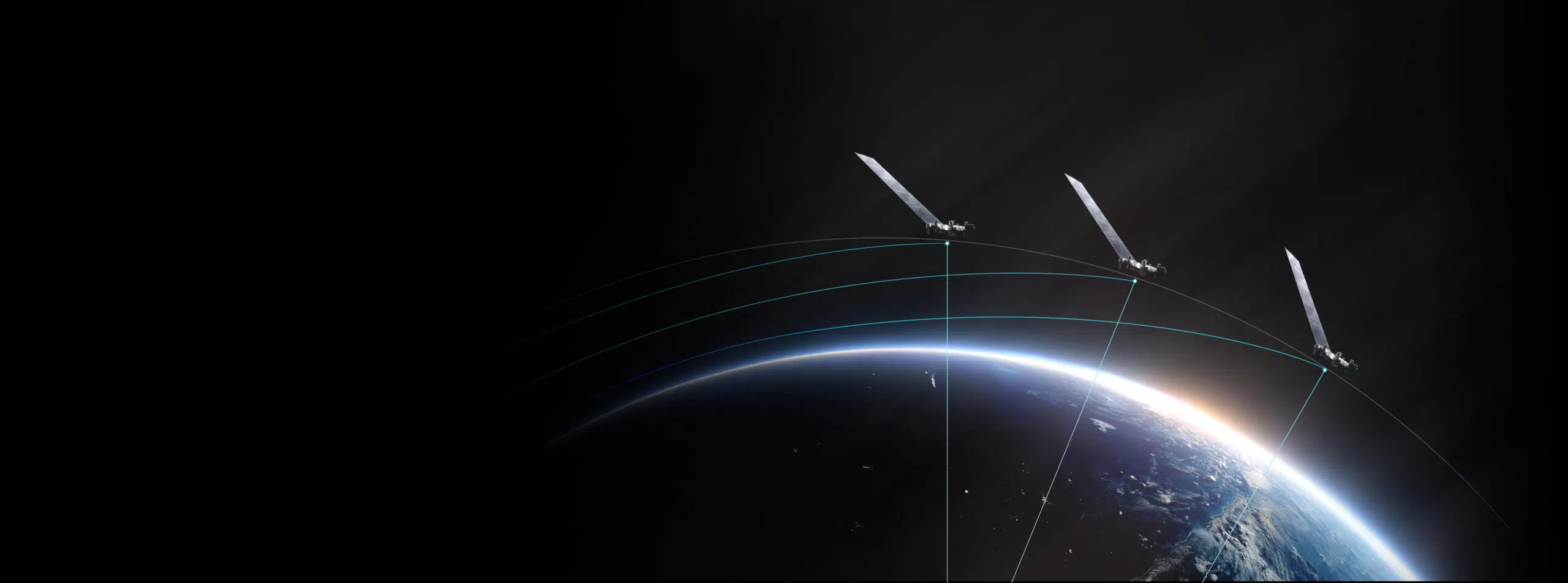
INSTRUMENT 04 OF 5 . GEN 2GNSS Radio Occultation
GNSS Radio Occultation
It reads the air by the bend in a passing signal. As GPS signals graze the atmosphere, air bends them. That bend reveals precise profiles of temperature, pressure and moisture through clouds and storms, while GPS atomic-clock timing provides a trusted forecasting anchor.


Overview
GNSS radio occultation measures how navigation signals bend as they graze Earth’s atmosphere. That refraction reveals high-resolution vertical profiles of temperature, pressure and humidity through clouds and in any weather—from the stratosphere down toward the surface.
- Measurement
- Signal bending
- Vertical resolution
- Approximately 200 m
- Outputs
- Temperature · Pressure · Humidity

The bend is the measurement
A straw looks bent where it enters a glass of water - light changes speed crossing into something denser. Air does the same to a radio signal: the denser, colder and moister the air, the more it bends the beam passing through it.
Radio occultation reads exactly that bend. As a GPS signal slices sideways through the atmosphere, measuring how much it curved reveals the temperature, pressure and humidity of the air it crossed - layer by layer, from the upper atmosphere down toward the ground, through any cloud, day or night.
Because the timing comes from the GPS atomic clock, the raw measurement is tied to a known physical standard — not to a sensor that must be re-checked over time. That stability is what makes it an atmospheric anchor.

Graze the limb, read the refraction
A GPS satellite sets behind the horizon as seen from a low-orbit receiver. In between, its signal slices sideways through the whole depth of the atmosphere and bends toward the denser air below.
Turn that bending angle into refractivity and you get the profile - temperature, pressure and moisture from the stratosphere down toward the surface, with vertical resolution reaching roughly ~100-200 m through key parts of the troposphere. The lower the ray grazes, the deeper the layer it samples.

One bend, a precise column
From a single occultation comes a uniquely sharp vertical profile in the atmosphere - and a reference the rest of the fleet leans on.
-
Bending-angle profile
The raw, near-measurement quantity weather centers assimilate directly.
-
Refractivity profile
The bridge from bend to atmospheric state.
-
Vertical temperature profile
High vertical resolution, reaching hundreds of meters through the troposphere.
-
Vertical humidity profile
Moisture retrieved from refractivity - often through a 1D-Var inversion.
-
Pressure & tropopause structure
Precise stratospheric pressure and tropopause structure.
-
Bias-anchor reference
Stable, low-bias observations anchor bias correction of satellite radiances.


Forecast value that keeps growing
Radio occultation is one of the highest-impact space-based thermodynamic modalities — and it still has room to scale. The more profiles assimilated, the better the forecast. Current studies continue to show meaningful gains as RO density increases, with no clear operational saturation point yet reached.
The trusted reference
Most satellite instruments drift, so forecast centers must correct their measurements. Radio occultation is different: GPS atomic-clock timing lets its data be used without bias correction and helps check infrared and microwave measurements across the fleet. Since around 2006, it has made stratospheric-temperature records more consistent.


Constellation Foundation
GNSS Radio Occultation reveals the atmosphere layer by layer - temperature, pressure, and moisture with exceptional vertical precision and stability. The rest of the constellation shows how that atmospheric state becomes clouds, rain, motion, and impacts at the surface.

THE FIVE INSTRUMENTS ARE ANNOUNCED. SEE WHAT THEY ARE BUILT FOR.
Book a demo of the platform DeepSky will feed, working today on the Gen-1 fleet, on the decisions your team actually makes.


