


What does it really mean to be “agentic”?
As tools continue to evolve, we’ll hear the word more and more. At Tomorrow.io, being agentic means putting intelligence where the work actually happens — on the asset, in the cockpit, inside the agent, and across the alerts your teams already depend on.
From a new Asset Insight Dashboard to a native MCP server, our Spring release is built for operators making real-time calls and for developers extending Tomorrow.io into the systems and agents they already run on.
Here’s what our new update brings to our customers and how it’s transforming their operations.
Move From Static Locations to Living Operations with Asset Insight Dashboard & Asset Monitoring
Altitude and Shield customers: your operational reality isn’t a pin on a map. It’s a flight in motion across changing airspace, or a portfolio of insured assets scattered across a region where the next storm is already forming. This release brings both realities into Tomorrow.io.

Business Outcome
For Altitude: Cut disruption, fuel burn, and delay risk by monitoring every active flight — with route, altitude, and crew context attached — instead of chasing weather airport by airport.
For Shield: Shrink loss exposure and accelerate claims response by monitoring every insured asset across your book — policies, properties, vehicles, infrastructure — with the metadata that matters to underwriting and claims traveling alongside each one.
What It Is
A new way to bring moving, attribute-rich operational objects directly into Tomorrow.io. Customers upload asset feeds through the Feed Management block and apply monitors to the entire feed in a single action under a dedicated license flag.
Each asset carries the attributes your business actually runs on. For Altitude, that’s flight number, tail ID, crew, fuel load, alternates, and altitude profile. For Shield, that’s policy number, insured value, coverage type, property characteristics, and any risk metadata your underwriting and claims teams depend on. Those attributes travel with the asset across the platform, so the context is always one click away from the weather signal.
The new Asset Insight Dashboard brings it all together: a dedicated section next to your locations that shows every asset in the feed, the insights affecting it, and daily and weekly outlooks. Click into a flight and the full route profile opens with altitude-specific risk. Click into an insured asset and you see the hazard exposure and the policy context side by side.

Available both on the map and in the Insights Dashboard page.
- Altitude — airlines, OCCs, dispatch, and flight operations teams monitoring active flights with METAR, TAF, en-route conditions, and altitude profiles tied to the actual route, not a static airport pin.
- Shield — carriers, MGAs, reinsurers, and claims operations teams monitoring insured portfolios where every asset has a story, a value, and a set of exposures that need to be visible the moment a hazard moves toward them.
Why It Matters
Aviation stops asking “what’s the weather at this airport?” and starts asking “what’s the weather along this flight, for this crew, at this altitude?”
Insurance stops asking “what’s the weather in this ZIP code?” and starts asking “which of my insured assets are exposed right now, and which policies and claims teams need to know first?”
Both are different classes of questions — and both lead to different classes of decisions.
See the Sky the Way Pilots Do Now Through 3D Map & Pilot View
Airlines, dispatchers, and flight operations teams: this is the visualization upgrade aviation has been waiting for.


Business Outcome
Give pilots and dispatch a shared, true-to-airspace mental model of every flight, so reroute and altitude calls happen faster and with more confidence.
What It Is
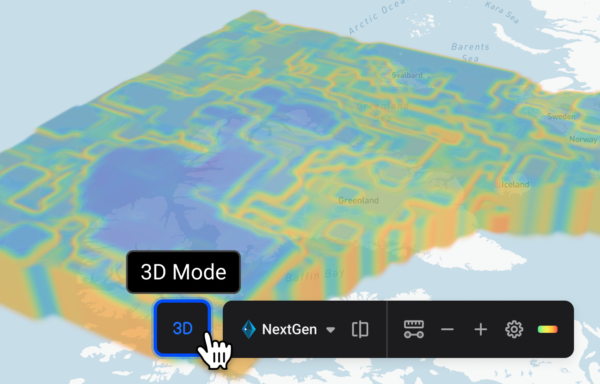
The map now supports a full 3D mode. Volumetric satellite cloud data is available to all customers. Storm tops, AIRMETs, and SIGMETs render in 3D for customers with the relevant layers. Load a flight from your route monitoring, and you can fly the route from above, drop into a pilot perspective from inside the cockpit viewpoint, or jump back to the route-level view, all using the same 3D environment.
Who It’s For
Airlines, OCCs, and drone operators are making time-critical decisions where altitude-specific weather matters. Tied to existing aviation, route monitoring, and next-gen satellite license flags.
Why It Matters
Top-down 2D maps abstract away the dimension in which aviation actually operates. Putting clouds, storm tops, and convective hazards in 3D, alongside the actual flight profile, closes the gap between “what the forecast says” and “what the aircraft is going to fly through.”
Native Weather Intelligence for Every AI Agent Tomorrow.io MCP Server
Engineering, AI, and platform teams: your agents and copilots can now leverage Tomorrow.io intelligence as a first-class input, no custom wrappers, no brittle glue code.

Business Outcome
Accelerate internal copilots and AI workflows by giving them direct, standardized access to the weather data your operations already trust.
What It Is
A native Model Context Protocol (MCP) server with tools for each of Tomorrow.io’s core APIs. Any agent framework that speaks MCP can query forecasts, severe weather, route insights, and more, with full URL and integration details available in the docs.
Who It’s For
Engineering teams building internal copilots, agent workflows, or AI-powered operational tools that need real-world weather context as a structured input. API key required, standard rate limits apply.
Why It Matters
The way teams build with AI is shifting from “wire up an API” to “give my agent the right tools.” MCP is fast becoming the standard for that, and Tomorrow.io is now there natively.
Tomorrow.io Inside Your Automation Stack with Connectors for n8n, Zapier & Make:
Operations, IT, and automation teams: weather intelligence is most useful where your workflows already live. Now it’s there.
Business Outcome
Trigger downstream actions, populate operational systems, and chain weather logic into existing automations — without custom integration work.
What It Is
Native connectors for n8n, Zapier, and Make, the three workflow platforms most operations teams already rely on. Pull weather data into a flow, trigger actions when a threshold is crossed, or fan out platform monitor outputs into your existing tooling. API key required.
Who It’s For
Any team running operational automations, from logistics dispatch to field service to internal Slack alerting, that wants weather logic as part of the flow.
Why It Matters
The fastest path we’ve ever offered for getting Tomorrow.io-driven decisions into the systems your teams actually operate in.
Tomorrow.io on the OpenAI App Store
For anyone curious about modern weather intelligence — including your prospects and your own teams — Tomorrow.io now lives where billions of conversations already happen.
Business Outcome
Put a tangible, hands-on Tomorrow.io experience in front of users with zero install friction.
What It Is
A Tomorrow.io app is available in the OpenAI App Store. Users install it once, then ask weather-related questions inside ChatGPT and get the Tomorrow.io widget experience directly in the conversation. No API key required.
Who It’s For
Anyone using ChatGPT, and any prospect, partner, or stakeholder who wants to see what we do in the most accessible format possible.
Why It Matters
We’re not the first weather provider in the OpenAI ecosystem, but we’re the most operationally serious one. The app showcases that.
Grouped Alerts: Less Noise, Sharper Signal
Operations teams managing many nearby locations: stop drowning in duplicative notifications when one storm system crosses a region.

Business Outcome
Calmer alerting for teams operating across dense, tagged geographies — without missing the events that matter.
What It Is
A new notification setting on alerts: group by tag. Pick “East Coast” and instead of getting ten notifications as a storm moves across ten locations, you get one notification when the first location triggers and an all-clear when the last one resolves. Cancellation and start-time-advanced notifications are also supported in this MVP.
Who It’s For
Existing alerts customers operating at scale across tagged location sets — logistics, retail, public sector, insurance, anyone monitoring dense regions.
Why It Matters
This is the noise-reduction upgrade alerts customers have been asking for. Phase 2, coming next quarter, will add richer update logic for new locations entering the group, duration changes, and registration for ongoing updates.
Location Subscriptions for Groups: One Alert, Routed Right
Admins managing alerts at scale: stop creating ten copies of the same alert just to route notifications to the right teams.

Business Outcome
Drastically reduce alert administration overhead — and the configuration drift that comes with maintaining hundreds of near-duplicate alerts.
What It Is
Groups can now have location subscriptions attached directly, including by tag. A single alert routes to the right recipients automatically based on the location-to-group mapping, no matter how many locations or groups are involved. Manual recipient overrides remain available for one-off cases. Built-in deduplication ensures no one receives the same alert twice, even when they belong to multiple groups.
This is the default behavior for new alerts going forward, and existing accounts can be cleaned up with help from your Tomorrow.io contact.
Who It’s For
Existing alerts customers — particularly large accounts running alerting across many locations, groups, and teams.
Why It Matters
One alert, five locations, five groups, the right recipients for each. The administrative load on customers running alerts at scale just got dramatically lighter.
Ready to Put These Updates to Work?
These capabilities are available now.
Existing customers can contact their Tomorrow.io Account Manager to learn more or view a demo of the new features. See how to enable asset feeds and monitoring, turn on 3D for your aviation workflows, configure grouped alerts and location subscriptions, or get started with the MCP server and workflow connectors.
New to Tomorrow.io? Book a demo to see how asset-level weather intelligence, 3D flight views, and an open agentic ecosystem can support your operations.


