BOSTON, MA — January 6, 2025 —Tomorrow.io, the world’s leading Resilience Platform™, today announced new peer-reviewed research demonstrating that its Tomorrow.io Microwave Sounder (TMS) constellation delivers positive water vapor forecast impacts in all cloud conditions, a long-standing challenge in numerical weather prediction, and a first for a commercial entity. Accepted by the Quarterly Journal of the Royal Meteorological Society, the study introduces and validates a new, end-to-end assimilation methodology. This is a precursor to Tomorrow.io’s satellite observations being used operationally in global weather forecast models..
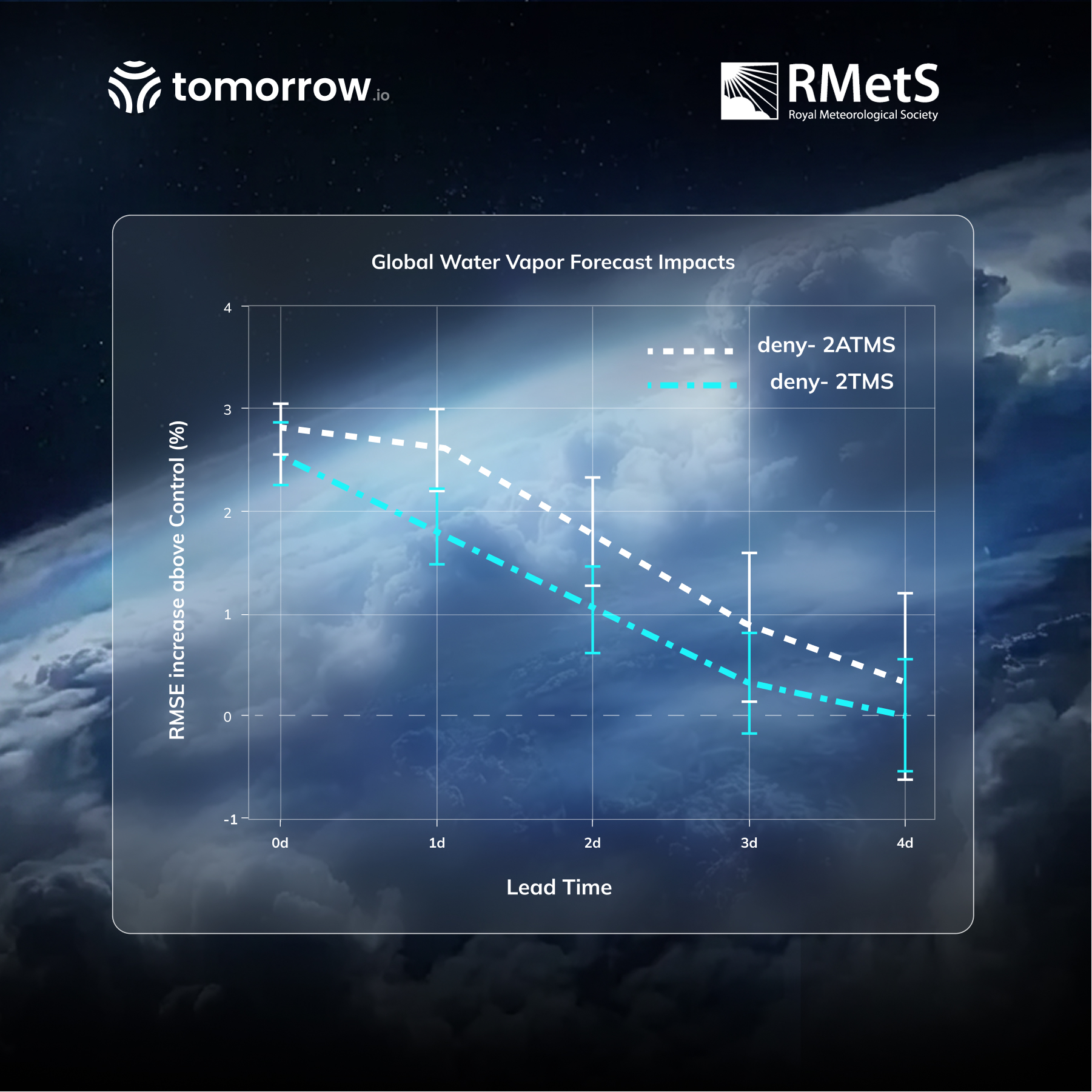
A core finding of the research is that Tomorrow.io’s purpose-built assimilation strategy, combining advanced error modeling, orbital bias prediction, and scene-specific filtering, allows TMS radiances to be effectively assimilated in cloud-affected environments. In direct comparisons with NOAA’s Advanced Technology Microwave Sounder (ATMS), the study shows that assimilating two TMS instruments delivers water vapor forecast impact comparable to two ATMS instruments across multiple forecast lead times, despite TMS operating on a fundamentally different satellite architecture.
The study also highlights the value of Tomorrow.io’s mixed-orbit constellation design. By deploying microwave sounders in both sun-synchronous and inclined orbits, Tomorrow.io captures fast-evolving atmospheric conditions in regions and time windows historically underserved by public satellite missions, particularly in the tropics and mid-latitudes where cloud-driven weather systems dominate. These more frequent observations provide critical inputs for improving forecasts of water vapor, a key driver of precipitation and severe weather.
Tomorrow.io Microwave Sounders deliver water vapor forecast impact comparable to NOAA’s ATMS across multiple forecast lead times.
Unlike traditional government-operated microwave sounders, TMS instruments are deployed on low-cost CubeSat platforms, enabling comparable forecast impact at a fraction of the mission cost and with significantly faster scalability. While the study evaluates results from a limited subset of instruments, Tomorrow.io now has nine TMS satellites in orbit, positioning the company to further scale these forecast benefits as computational capacity and operational testing expand.
“This research shows that our constellation is not just providing more data: it’s providing the right data in the hardest conditions,” said Shimon Elkabetz, CEO and Co-founder of Tomorrow.io. “Cloud-affected regions are exactly where forecasts often break down. The fact that our sounders deliver reliable, usable insights in these moments represents a major step forward for global early-warning systems.”
The submitted version of this paper is now available here: https://zenodo.org/records/17362648
About Tomorrow.io
Selected by TIME Magazine as one of the Top 100 Most Influential Companies in the World, Tomorrow.io is the world’s leading Resilience Platform™. Combining next-generation space technology, advanced generative AI, and proprietary weather modeling, Tomorrow.io delivers unmatched forecasting and decision-making capabilities. Trusted by six of the top ten Fortune 500 companies, Tomorrow.io empowers organizations to proactively manage weather-related risks, opportunities, and enhance operational efficiency. From cutting-edge weather intelligence to real-time early warning systems, Tomorrow.io enables predictive, impact-based action for a safer, more resilient future. Learn more at Tomorrow.io.