Lufthansa operates nearly 800 flights a day across one of the most complex route networks in the world. For a carrier of that scale, the margin between a good operational decision and a costly one is often measured in minutes — and the quality of that decision depends almost entirely on how quickly the right information reaches the right person.
Lufthansa decided that the architecture of weather and its relationship to their operation was no longer good enough and decided to innovate from the bottom up.
What followed was a fundamental rethink of how weather intelligence moves through the operation — away from manual workflows and fragmented tools, and into the systems and workflows that actually run the airline. The results have set a new benchmark for what aviation weather technology can and should do.
Today, Tomorrow.io is proud to launch Altitude™ — the enterprise platform that makes this possible — and to spotlight Lufthansa as the carrier showing the industry what operational weather intelligence looks like when it is built the right way.
Rethinking Weather Across the Network
Lufthansa did not arrive at this problem the way most airlines do — reactively, after a costly disruption, looking for a better forecast. They arrived at it strategically, asking a more fundamental question: why is weather intelligence still something our people have to go looking for?
The gap they identified was not in data availability. It was in data placement. Most airlines already have access to forecasts, reports, local feeds, and experienced teams that know how to interpret them. But for most, weather intelligence still tends to sit outside the operating core — layered across maps, checked manually, and moved into decisions through repeated administrative effort rather than by design.
At Lufthansa’s scale, that gap has a price. A single diversion decision made on incomplete weather intelligence can cost anywhere from $22,000 to over $240,000 — for one flight. Across a network of nearly 800 daily flights serving more than 150,000 passengers, that exposure compounds in every direction: fuel, compensation, crew, reputation, and the downstream ripple through a network that never fully stops moving.
Lufthansa’s response was not to just find better data. But to also build a better architecture around it — one that treats weather as a programmable layer inside the operation, not a reference tool sitting alongside it. Finding a partner capable of making that vision real was the next step. That partner was Tomorrow.io.

Architecting Intelligence into Operations
Lufthansa’s operations control center manages one of the most demanding networks in commercial aviation — and for years, like most carriers, it did so with a weather workflow that was inherited rather than designed.
The pattern was familiar: a team watches the weather across the core hubs, scans outward, compares inputs, determines what matters, publishes a report, routes it downstream, and leaves it to the teams to connect it to their responsibilities. Repeat. Every connection in that loop was a manual one, made by a person, every time. At Lufthansa’s scale, that is not a minor inefficiency. It is an architectural constraint that touches every corner of the operation.
The answer was not to add another interface on top of that architecture. It was to reenvision what could be done — the result: building weather intelligence into the model that already runs the airline rather than alongside it.
That decision reframes what the right platform actually looks like. Forecast quality is still necessary — but it is no longer sufficient on its own. The questions asked were not just about data. They were about design: Can the system support a single coherent global view configured around Lufthansa’s own operational rules? Can it surface what matters without requiring people to continuously watch for it? Can it deliver intelligence directly into existing tools through APIs — eliminating the manual bridging that consumes so much bandwidth?
Those were not procurement details. They were Lufthansa drawing the outline of a categorically different kind of platform.
Lufthansa put it plainly: “Our partnership with Tomorrow.io is not only about the information they unlock, but also the capabilities to integrate into our systems — making it easy for our people to use the insights our datasets deliver together and have it on hand where they need it, in the tools most valuable to them.”
The winning solution is not the one with the most impressive screen. It is the one that earns its place inside the operation — purpose-built to make everything around it work better.
Going From Scanning to Steering
Lufthansa did not go looking for a better tool. It went looking for a better way to run the operation — and the clearest measure of that ambition is what the operations control center actually spends its time doing now versus before.
When the system monitors continuously, flags relevant changes, and brings information to the point of decision automatically, something fundamental changes for the people in the room. The decisions still belong to them — but they arrive at those decisions faster, with greater confidence, and without the cognitive overhead of assembling the picture themselves. Less scanning. Less translation. Less time lost moving between tools to find what the operation should already know.
Dirk Dewald, Senior Director at Lufthansa, describes the before and after in direct terms:
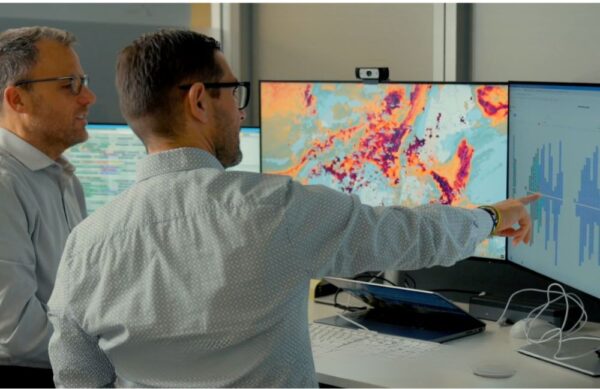
“Prior to our partnership with Tomorrow.io, our greatest weather challenge was getting a truly holistic picture globally. Tomorrow.io has allowed us to unify operations under a single global standard, applying our specific operational rules — so we no longer have to manually scan the globe. We now rely on an integrated platform that proactively alerts us the moment a situation requires our attention.”
The principle at work here extends beyond weather. Expert teams create the most value when their attention is on judgment, coordination, and the decisions that genuinely require human expertise — not on information retrieval the system should handle automatically. Every minute an experienced operator spends hunting for context is a minute not spent acting on it. Building an operation around that distinction is what separates real transformation from a better-looking dashboard.
Introducing Altitude™
The Infrastructure Behind the Breakthrough
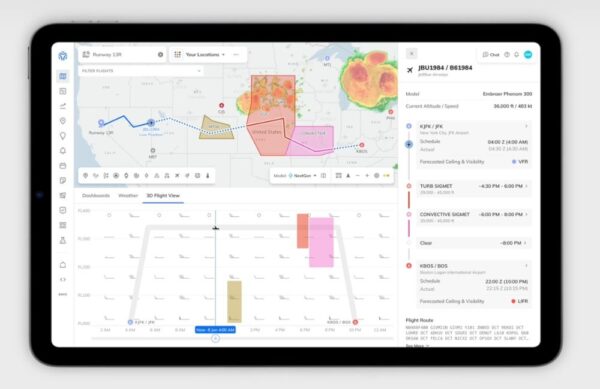
Altitude is not a standalone weather product. It is infrastructure — purpose-built to embed weather intelligence directly into the systems, workflows, and decision layers that run an airline. Built on Tomorrow.io’s proprietary satellite constellation and rapid-refresh AI weather models, combined with a full end-to-end integration layer and the agentic capabilities of Gale, Tomorrow.io’s artificial intelligence engine, Altitude delivers globally consistent, high-resolution forecasts through standardized APIs, rule-based alerting configured around each operator’s own logic, and continuous network-wide monitoring. It does not ask airlines to adapt to it. It is built to embed into how they already operate.
What makes Altitude categorically different is not the data alone — it is what becomes possible when data that is precise enough, global enough, and programmable enough is connected directly to the decisions that matter. No previous platform has brought those capabilities together in a single operational system that is both extensible and also able to be leveraged as a standalone product.
Lufthansa is already using that foundation to connect forecast intelligence directly to network decisions — assessing which routes are exposed, which windows are viable, and which situations need attention before they become critical.
Dewald is unambiguous about where it leads: “Tomorrow.io has been a fast, smart, valuable partner in advancing AI-driven predictive decision models and in redefining what is possible. We see a future where they become foundational infrastructure for aviation — something no major airline will be able to operate without.”
That operating model requires a specific kind of platform to function. Altitude is how Tomorrow.io delivered.
The Standard Is Moving
What Lufthansa has deployed with Altitude is a demonstration of what the entire industry can become. The carriers that get there first will share a common set of decisions: to treat weather as a programmable layer rather than a reference tool, to build for continuous awareness rather than periodic checking, and to measure the value of a platform not by what it shows but by how deeply it integrates into the decisions that matter. Those are not technology preferences. They are operational commitments — and they are what separate airlines that react to disruption from those that anticipate it.
The enterprise standard in this category is being set now. It will be defined by integration depth and prediction performance together — by platforms that can sit at the center of how an airline makes decisions, not alongside it.
Shimon Elkabetz, CEO of Tomorrow.io, sees this moment as a turning point for the industry: “Aviation has always been defined by the quality of its decisions under pressure. What we are building with Altitude — and what Lufthansa is proving in operation — is that weather no longer has to be something airlines react to. It can be the layer that powers how they think, plan, and act. That is the future we are building toward, and it is closer than most people realize.”
Lufthansa is one of the world’s most operationally complex carriers, and it is already operating at that standard. That is what makes this story worth telling — not as a case study, but as a signal of what can become when the right architecture is envisioned and the right teams are there to make it happen.
Altitude is Tomorrow.io’s commitment to making that standard accessible, scalable, and built for what comes next.